Consultant Oral & Maxillofacial Surgeon · London
Surgery of the face, jaws and mouth – planned precisely, explained clearly.
Will Rodgers is qualified in both medicine and dentistry, holds a research doctorate from UCL in surgical bioengineering, and completed an international fellowship in facial deformity. He leads the orthognathic (corrective jaw) and TMJ services at Homerton University Hospital, with subspecialty interests in TMJ arthroscopy, sialendoscopy, paediatric oral & maxillofacial surgery and dentoalveolar surgery, including wisdom teeth. He also treats obstructive sleep apnoea, facial skin cancer and mouth conditions.
MBBS (Distinction) · BDS · MRCS · AKC · FRCS (OMFS) · MD(Res)
About Will
A surgeon, an engineer's collaborator and a teacher.
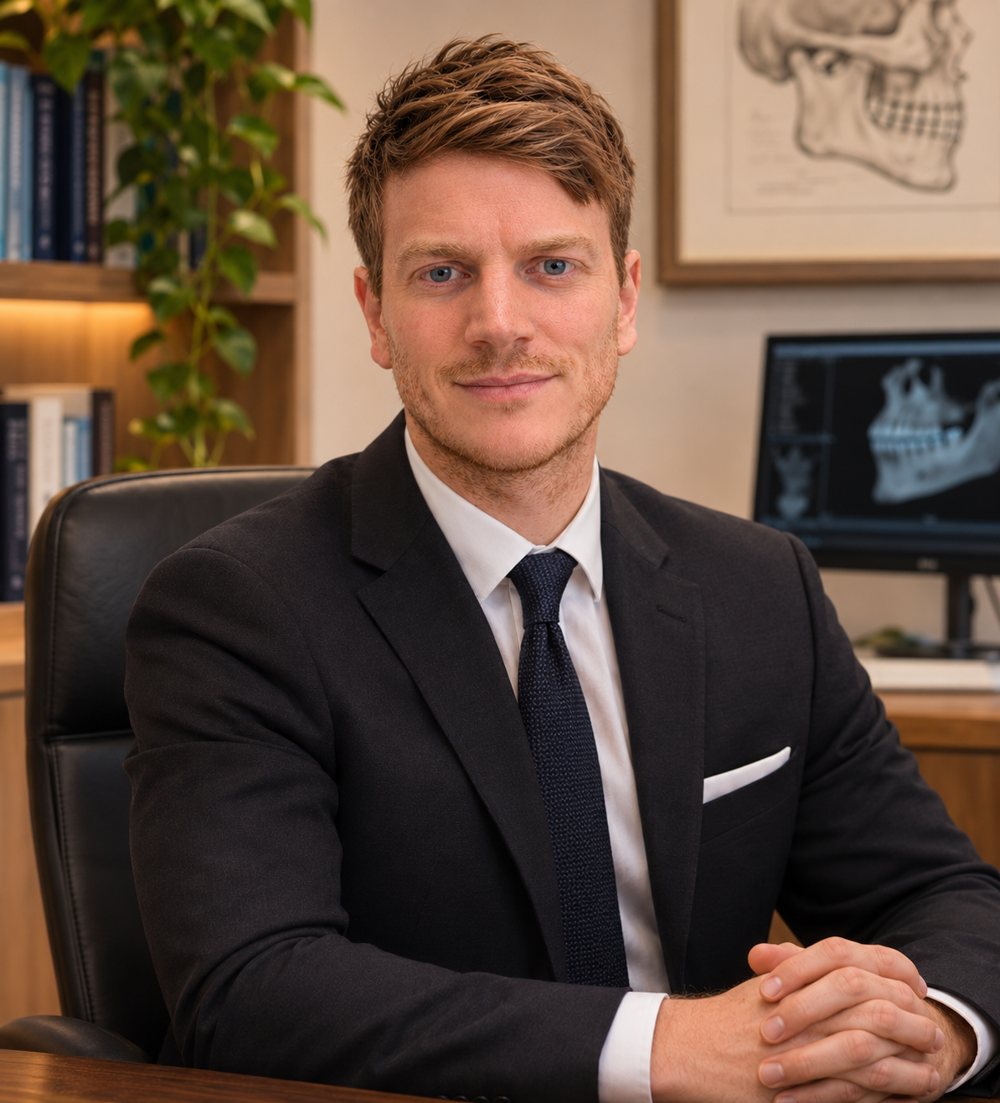
Will is a Consultant Oral and Maxillofacial Surgeon at Homerton University Hospital in east London, where he is the lead for orthognathic (corrective jaw) and TMJ surgery. He set up the hospital's TMJ arthroscopy service, offering arthroscopy from diagnostic to advanced disc procedures, and is developing its orthognathic service with a consultant orthodontist. He is a member of the skin cancer multidisciplinary team and runs joint skin clinics with dermatology.
His higher surgical training took him through the London units at Great Ormond Street, the Royal London, University College Hospital, Northwick Park and the Royal Free, followed by a fellowship in facial deformity at the Royal Children's Hospital, Melbourne. There he used virtual surgical planning for jaw and TMJ surgery and was part of the team that carried out Australia's first paediatric TMJ replacement.
Alongside his clinical work, Will sits on the Editorial Advisory Board of the British Journal of Oral and Maxillofacial Surgery, reviews for Neurosurgical Review and the Journal of Maxillofacial and Oral Surgery, and is a GMC-recognised Educational Supervisor for dental core and specialty trainees.
Subspecialty interests
- Orthognathic & facial contouring surgery
- TMJ disorders & arthroscopy (Levels 1–3)
- Sialendoscopy & salivary gland disease
- Paediatric oral & maxillofacial surgery
- Dentoalveolar surgery, including wisdom teeth
Where Will trained
- Royal Children's Hospital, MelbourneMaxillofacial fellowship, facial deformity
- Great Ormond Street HospitalCraniofacial, cleft and maxillofacial surgery
- The Royal London HospitalMajor trauma, TMJ and head & neck surgery
- University College HospitalHead & neck oncology and salivary surgery
- Northwick Park & Royal FreeOrthognathic, skin cancer and reconstructive surgery
Conditions & procedures
Clear information before you decide.
Each guide explains what the treatment involves, who it may help, recovery, the main risks and the alternatives – including not having surgery.
Your care, step by step
Decisions made together, with time to think.
- 01 Assessment A full history and examination, with imaging only when it will change your treatment.
- 02 Planning Where it helps, 3D virtual surgical planning and discussion with the wider team – orthodontists, dermatologists, radiologists or the head & neck MDT.
- 03 Shared decision The benefits, risks and alternatives that matter to you, in writing. Consent is never taken on the day you first hear about an operation.
- 04 Treatment & recovery Day-case surgery where it is safe, a written aftercare plan and follow-up only when it adds value to your care.
Standards
Care built on national guidance
Will's practice follows the recommendations of the national bodies that set standards for this specialty, and he audits his own outcomes.
- GIRFTGetting It Right First Time national report on OMFS: day-case surgery where safe, networked specialist care and no unnecessary follow-up.
- NICEWisdom teeth are removed for a clear clinical reason, not as a routine preventive step.
- GMC consent guidanceDecision making and consent: you are given the information you need, including the option of no treatment.
- BAOMS & BAHNOSpecialty and head & neck standards, including multidisciplinary review of every skin and oral cancer.
Research & innovation
From the engineering lab to the operating theatre.
Will's MD(Res) at UCL brought surgeons and biomedical engineers together to design a personalised, 3D-planned internal device for lengthening the lower jaw in children with craniofacial microsomia. The work led to a patent and to published computer models of how springs reshape the skull in craniosynostosis surgery.
Publications, chapters and presentations →- Plastic & Reconstructive Surgery · 2017 · First authorSpring-assisted cranioplasty for non-syndromic scaphocephaly: a quantitative analysis of 100 consecutive cases
- British Journal of Oral & Maxillofacial Surgery · 2018 · First authorAdvancing the mandibular distractor
- Hamilton Bailey's Emergency Surgery, 14th ed. · 2024 · ChapterMaxillofacial trauma (with Professor Simon Holmes)
- World Health Organization · 2016–2017 · Contributing authorNoma prevention, early detection and management resources for the WHO Africa region
Questions patients ask
Frequently asked questions
What does an oral and maxillofacial surgeon do?
Oral and maxillofacial surgeons are specialists who qualify in both medicine and dentistry. They diagnose and treat conditions of the face, jaws, mouth and neck – including jaw alignment, jaw joint (TMJ) problems, wisdom teeth, salivary gland disease, facial injuries and skin cancer of the face.
How can I see Will Rodgers?
Ask your GP or dentist to refer you to the Oral & Maxillofacial Surgery department at Homerton University Hospital, Homerton Row, London E9 6SR. NHS patients in England can choose the consultant-led team for their first appointment, so your GP can name Mr Will Rodgers on the referral.
Does Will Rodgers treat children?
Yes. Paediatric oral and maxillofacial surgery is one of Will's subspecialty interests. He trained at Great Ormond Street Hospital and completed a fellowship at the Royal Children's Hospital, Melbourne.
What is TMJ arthroscopy?
TMJ arthroscopy is keyhole surgery on the jaw joint, using a camera less than 3 mm wide passed through a small incision in front of the ear. Level 1 examines and washes out the joint, Level 2 treats adhesions and inflamed tissue, and Level 3 repositions and secures a displaced disc. Will offers all three levels, usually after self-care and non-surgical treatment have been tried.
Can jaw treatment help obstructive sleep apnoea?
For some people, yes. After a sleep study, a custom mandibular advancement splint that holds the lower jaw forward at night can be an alternative to CPAP. For selected patients, jaw advancement surgery (maxillomandibular advancement) enlarges the airway. CPAP remains the main treatment for moderate and severe sleep apnoea.
What is sialendoscopy?
Sialendoscopy is a gland-preserving keyhole technique in which a very fine camera is passed into a salivary gland through its natural opening inside the mouth. It is used to remove salivary stones, widen narrowed ducts and investigate repeated gland swelling.
Do I need my wisdom teeth removed?
Not always. NICE advises that wisdom teeth should not be removed routinely, only when there is a clear reason such as repeated infection, decay that cannot be repaired, or damage to nearby teeth. Dentoalveolar surgery, including wisdom teeth, is one of Will's subspecialty interests.
What are Will Rodgers' qualifications?
MBBS (Distinction) and BDS from King's College London, MRCS and FRCS (OMFS) from the Royal College of Surgeons of England, and an MD(Res) research doctorate from University College London. He is on the GMC Specialist Register for Oral & Maxillofacial Surgery (GMC 7014473).